
// LORE: TIMELINE OF EVENTS
2163
Christian Orwell, a prodigious scientist employed by Trinity, witnessed one of the organization’s experiments involving the development of biological weapons. Horrified by the nature and implications of the research, he defected from the organization. Several months later, Orwell publicly introduced his own counter-bioterrorism organization, the Meridian Group, with the primary objective of preventing Trinity and other corporations from developing and deploying biological weapons.
2164-2165
The Meridian Group experienced rapid expansion along the eastern coast of North America, establishing numerous camps in strategically important cities, alongside several laboratories dedicated to researching cures and countermeasures against biological weapons.
Recognizing the potential benefits of Meridian’s operations, the remaining established nations, including the Northeastern Union, Southern Union, and Midwestern Union, granted the organization permission to operate within their respective territories. Meridian was widely regarded as a necessary force working towards the preservation of what remained of humanity.
Early 2166
As Trinity’s experiments became increasingly ambitious and reckless, several biological weapons were released, wreaking havoc throughout the Great Lakes region. Meridian intervened, eventually dismantling the organization with assistance from NeuraLife, a small medical clinic operating on Sunrise Island.
Following Trinity’s collapse, Meridian became involved in the conflicts between the various militia groups competing for control of the organization’s remaining resources, facilities, and research. The fighting gradually weakened these factions, allowing Meridian to intervene and eliminate the remaining opposition, effectively bringing the conflict to an end.
However, the struggle for Trinity’s remnants came at a considerable cost. During the fighting, a viral bioweapon known as Red Hunger escaped containment, triggering a widespread outbreak. Meridian responded by establishing the Great Lakes Exclusion Zone (GLEZ), sealing off a substantial portion of the northeastern United States to contain the infection.
Since then, Meridian has maintained an extensive presence within the exclusion zone, conducting operations to eradicate infected populations and nests while simultaneously pursuing the development of a viable cure.
Late 2166
In the aftermath of the Red Hunger outbreak, the remaining nations relocated their borders beyond the GLEZ and effectively isolated themselves from the affected territories. Their governments provided little information to the public regarding the outbreak or the situation within the exclusion zone, fueling widespread distrust and civil unrest.
The resulting unrest escalated into numerous riots, coup attempts, and eventually full-scale civil wars within the Midwestern Union and Eastern Union, the latter having previously been known as the Northeastern and Southern Unions.
Following the conclusion of these conflicts, the surviving populations began rebuilding their respective territories under newly established governments and political systems. This period of reconstruction gave rise to three new nations: Port Liberty, New Providence, and the Palmetto Republic.
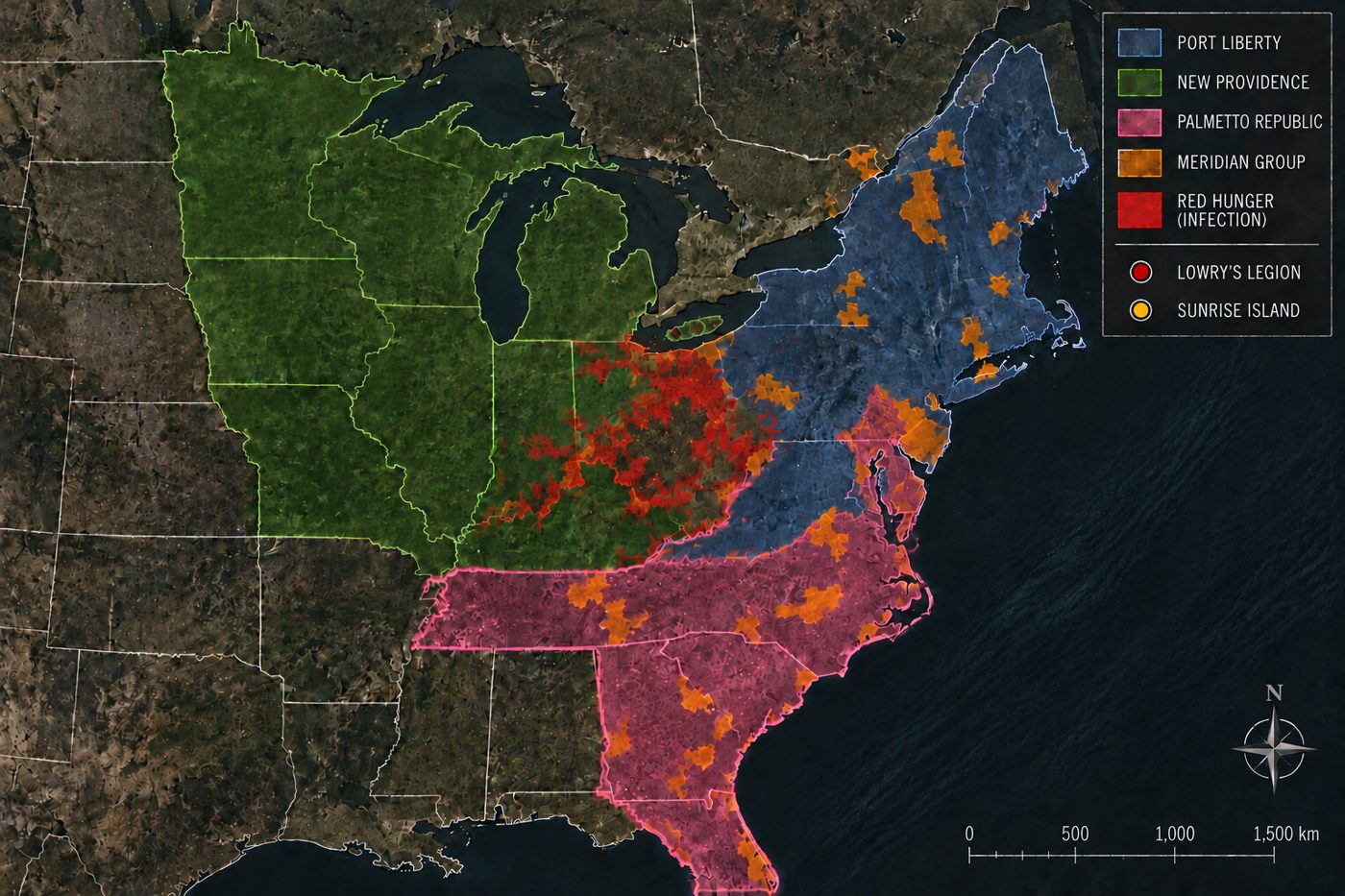
The emergence of these new political entities presented Meridian with an entirely new set of challenges. Previously established relationships and agreements had been disrupted, forcing the organization to navigate an increasingly complicated political landscape while attempting to maintain its operations and pursue its original objectives.